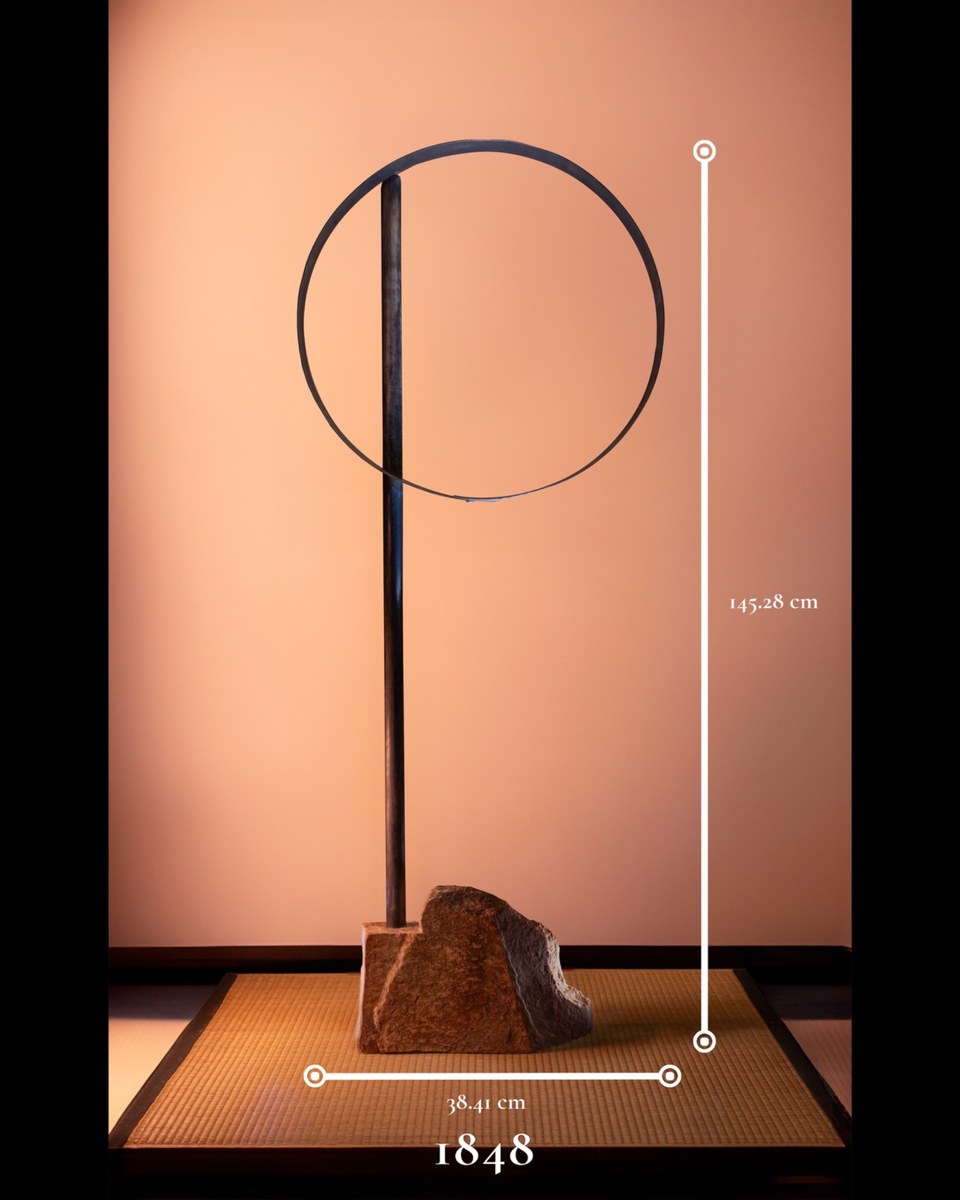
The title is a date, but the work is not an illustration of a historical event. It uses 1848 as a pressure point: the Treaty of Guadalupe Hidalgo transferred California from Mexico to the United States and accelerated a new legal order of survey, property, settlement, and extraction.
Stone as older time
The base is not a pedestal added after the fact. It is the ground from which the work is allowed to exist. Its irregular surface resists the clean geometry above it. It carries mineral time and points toward Indigenous presence that predates every later border, road, parcel, and title document.
The pipe as infrastructure
The vertical blue steel pipe is both support and intrusion. It can be read as a well, fence post, claim marker, utility line, weapon, or piece of unfinished industrial architecture. It makes occupation physical.
The hoop as contradiction
The gun-blued whiskey hoop is the most visually complete element, yet it contains the most unstable associations. It can become a barrel, boundary, target, halo, wound, horizon, or closed system. Whiskey suggests trade, intoxication, colonial exchange, and a romantic Western mythology that often concealed brutality and displacement.
Beauty does not resolve violence
The finish matters because it is attractive. Gun-blue darkens and preserves steel, producing a surface that feels controlled, elegant, and severe. The sculpture does not ask the viewer to choose between beauty and violence. It asks how often beauty is used to carry violence into memory.
The resulting object feels like a monument from an alternate history—quiet enough to enter a contemplative room, but unable to become neutral within it.